
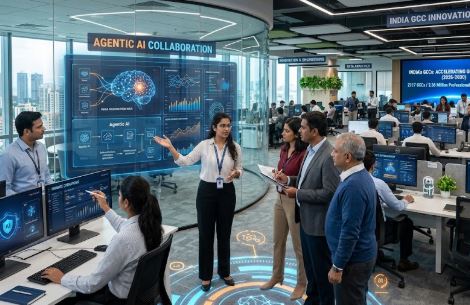
India’s Global Capability Centres (GCCs) are entering a new phase of growth, with artificial intelligence expected to reshape the way they work and strengthen their contribution to global businesses by 2030.
GCCs, which were once largely focused on technology support, finance and other back-office functions, have steadily taken on more specialised responsibilities. Today, many centres in India are involved in product development, engineering, data analytics, cybersecurity, research and artificial intelligence.
The growing use of AI could accelerate this transformation. In particular, agentic AI has the potential to change how GCC employees handle day-to-day work by helping complete multiple connected tasks rather than focusing on a single activity.
For instance, AI-enabled systems could collect information, analyse data, prepare reports and identify issues for human teams to review. Similar applications could be used across finance, technology, customer services, human resources and supply-chain operations.
According to the latest Nasscom-Zinnov GCC Landscape Report, India had 2,117 GCCs employing around 2.36 million professionals as of FY26, while the sector generated about $98.4 billion in revenue. The number of GCCs has grown significantly in recent years, reflecting India's expanding role in global business operations.
The impact of AI is already visible across the sector. An Infosys 2026 AI First GCC Index found that 499 of 500 GCCs surveyed had deployed AI, while 75 per cent of GCC functions were AI-supported. The findings also showed that many organisations are still working to convert AI adoption into measurable business benefits.
This shift could change the traditional GCC model. Instead of expanding mainly by adding more employees to handle larger workloads, companies could increasingly combine human expertise with AI tools to increase productivity and manage more complex operations.
The change is also likely to influence employment and skills. Repetitive activities could increasingly be automated, while demand could grow for professionals with expertise in AI, data science, cloud technology, cybersecurity, automation and digital engineering.
At the same time, employees with strong business and industry knowledge are likely to remain important. AI systems still require people who understand the purpose of a process, can assess results and make decisions when situations require human judgement.
The growth of AI could also strengthen the role of Indian GCCs in global innovation. Teams based in India are increasingly involved in developing products and technology solutions for international markets. As AI adoption grows, these centres could take on greater responsibility for building AI applications, improving business processes and supporting technology strategies for their global organisations.
Research from PwC suggests that agentic transformation could reduce dependence on linear workforce expansion while increasing delivery capacity through greater use of AI-enabled work. The actual impact, however, is likely to vary across industries and business functions.
The financial and technology sectors, manufacturing, healthcare, retail and professional services could all see different forms of AI adoption depending on the nature of their operations.
India's large technology talent pool gives the GCC ecosystem a strong base for this transition. However, companies will need to invest in training as the skills required for AI-driven workplaces continue to evolve.
By 2030, India's GCCs could therefore look very different from the centres established two decades ago. They could increasingly serve as technology and innovation engines, combining skilled professionals with AI to develop products, improve operations and support global business growth.
The rise of AI is ultimately shifting the GCC conversation from how much work can be delivered from India to how much new value can be created from India.