
GIFT City, Gujarat, Sep 29: The Indian AI Research Organisation has completed the inaugural cohort of Pramana: The Science of Purposeful AI, its SLM++ Bootcamp designed to give emerging AI talent hands-on experience in building Small AI systems from the ground up. Launched on August 15, the five-week programme brought together 100 participants selected from more than 120 applications, including faculty, industry professionals, students and emerging researchers from institutions and industries such as IIT Gandhinagar, BITS Pilani, Ahmedabad University, Plaksha University, IIT Guwahati, IIIT Dharwad and Western University.
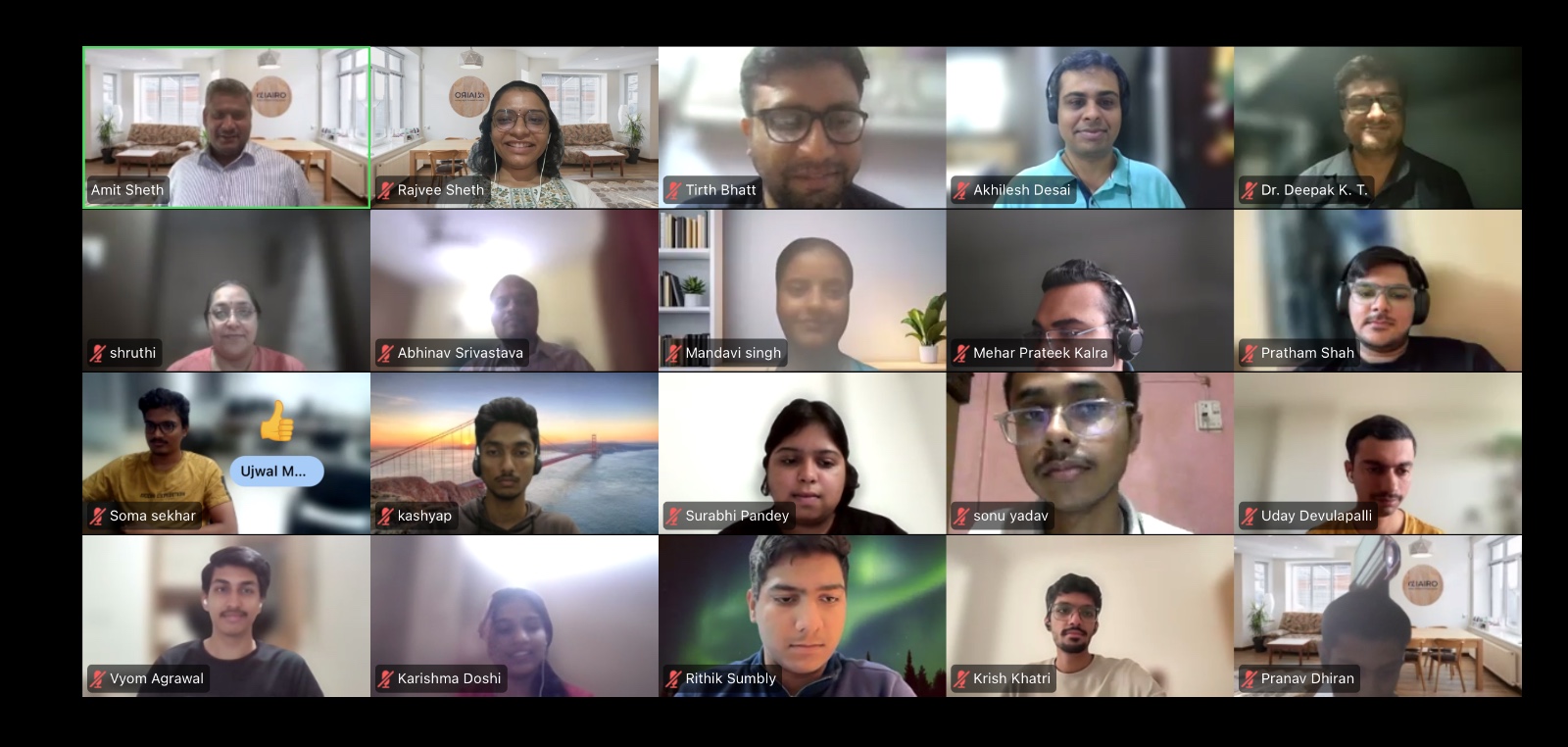
Rather than focusing on how to use existing AI models, Pramana took participants below the API layer, covering the technical foundations required to build and deploy custom, compact, and composite small language models, including data engineering, model architecture, pre-training, post-training, evaluation, edge deployment, optimisation and inference. The programme focused on exposure to different stages of small AI development lifecycle:
Across 11 sessions, including a special session by Dr. Amit Sheth, participants progressed from deep learning and PyTorch fundamentals to implementing a Vanilla GPT-2 architecture from scratch, followed by modern SLM architectures and Mixture-of-Experts, data engineering, scaling laws and cost accounting, distributed model training, alignment and reinforcement learning, edge deployment, optimization, and comprehensive evaluation. Each topic was accompanied by playbooks delivered as Python notebooks, giving participants hands-on experience that ultimately enabled them to build a small AI model from scratch. The programme also introduced participants to neurosymbolic AI and knowledge graphs.
The sessions were led by PhD students , Interns from the AI Institute at the University of South Carolina and Research Interns from IAIRO.
Dr Amit Sheth, Founding Director and CEO, IAIRO, said,
“India’s AI opportunity requires more than a large pool of people who can use AI. We need researchers and builders who understand how these systems work and can make informed decisions about data, architecture, training and deployment. Pramana is an effort to build that depth of capability early, giving the next generation of AI talent the foundation to create systems that are efficient, purposeful and relevant to India’s needs.”
The programme brought together the research, government, and technology ecosystem, with NVIDIA and Ahmedabad University as technical sponsor for GPU and participation/support from organizations including the Department of Science & Technology, IndiaAI, MeitY, ANRF, Ahmedabad University and AIISC. Industry and research stakeholders complemented IAIRO's hands-on approach to developing practical AI capabilities.
Smt. P. Bharathi, IAS, Department of Science & Technology, said:
“Strengthening India’s capabilities in artificial intelligence requires sustained investment in both research and talent. Initiatives that give young researchers and practitioners the opportunity to engage with emerging AI technologies, experiment with new approaches and develop practical capabilities can play an important role in building this ecosystem. Pramana reflects the value of bringing research, education and technology stakeholders together to nurture the talent and capabilities that will contribute to India’s AI-led innovation.”
The capstone phase features the teams developing domain-specific Small AI models across areas including Indian criminal law and IPC, biomedical applications, oncology, multilingual Indic language understanding across 11 languages, Gujarati and Hindi language understanding, and mathematics education. Among the winning projects, OncoPilot, a Small AI model designed for breast cancer oncology, highlights the potential of domain-specific AI in specialised healthcare applications.
Through these projects, participants applied the concepts covered during the bootcamp to independently build and evaluate their own Small AI models. The top one to two participants will also have the opportunity to undertake an on-site internship with IAIRO, providing a pathway to gain further research experience and contribute to ongoing AI research and development.
For IAIRO, Pramana represents an early step towards building a deeper pipeline of AI researchers and innovators in India. Its focus on Small AI reflects the need for systems that can be tailored to specific tasks, domains and deployment environments, particularly where efficiency, data control and predictable performance are important.
Through Pramana, IAIRO aims to empower the next generation of AI builders to develop Small AI models for India's diverse domains and beyond. With the inaugural cohort now complete, IAIRO is evaluating the programme's learnings and exploring the next phase of the initiative to create further opportunities for emerging AI talent to move from learning AI to building it.