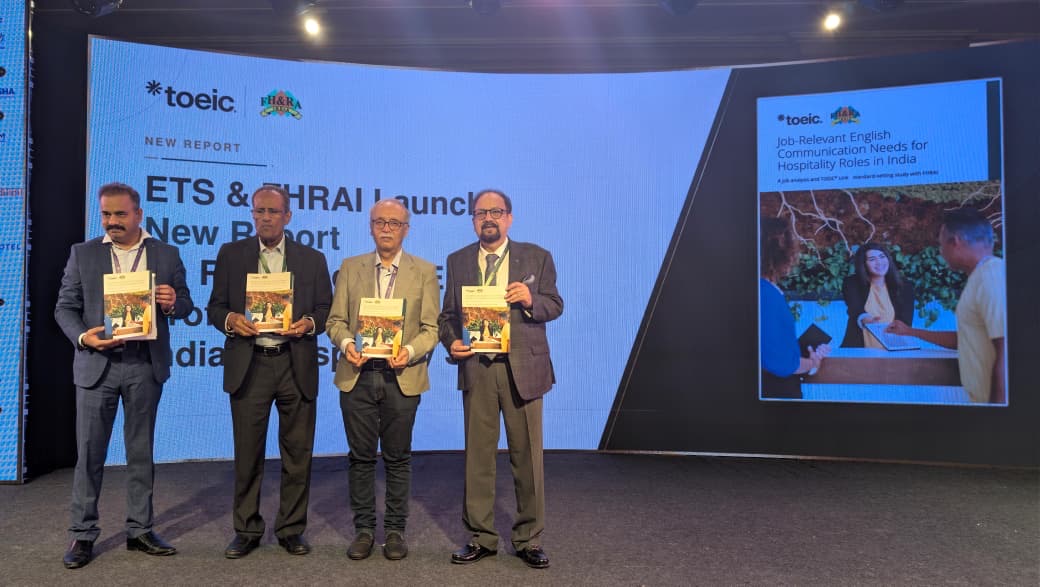
Aug 24: The ETS and the Federation of Hotel and Restaurant Associations of India launched a report titled, Job-Relevant English Communication Needs for Hospitality Roles in India at FHRAI's 56th Annual Convention in Varanasi. This job analysis and TOEIC Link standard-setting study was conducted to identify the minimum English language proficiency required for six target hospitality roles; representing junior and senior positions across Front Office, Food & Beverage and Housekeeping departments to give India's hospitality industry its first evidence-based benchmarks for how much English each job actually requires.
The study finds that a role's proficiency needs are shaped more by its day-to-day communication demands than by seniority. Junior Housekeepers, for instance, needed stronger Listening, Reading and Speaking skills than Senior Housekeepers, given their direct guest-facing duties compared to the more internally focused role of senior staff. The reverse held true in Front Office and Food & Beverage, where senior positions demanded notably stronger writing proficiency, tied to responsibilities like policy documentation and occupancy reporting. Speaking stood out as one of the strongest requirements across guest-facing roles, reflecting the real-time demands of understanding guests, handling complaints and responding clearly. Food & Beverage roles showed the most complex communication demands overall, spanning guest service, staff management and client interactions. Across the board, most roles required a working, practical level of English, with a smaller number of functions, mainly senior writing tasks, calling for a noticeably higher standard, reinforcing that hotels are better served assessing English needs by role and skill rather than one generic benchmark.
“India's hospitality industry has grown rapidly over the past decade, and with that growth has come a workforce operating in an increasingly international, English-mediated environment. What this research shows us, role by role, is that the level of English proficiency required has far less to do with a person's seniority than with the specific responsibilities their job carries day to day. For an industry of our scale, that is a meaningful distinction to have on record. It gives hotels and restaurants across the country a shared reference point to build hiring criteria, training investment and career development around, tailored to the realities of each role rather than assumptions tied to title. We see this as the beginning of a broader effort to bring the same rigour to other aspects of workforce readiness across the sector," said Surendra Kumar Jaiswal, President, FHRAI.
The study reflects a broader shift in how hotel groups view frontline roles such as guest relations, front office and reservations, treating them as strategic touchpoints that protect brand reputation rather than purely operational functions. In India, where properties serve both domestic and international travellers under globally benchmarked service standards, the pressure on customer-facing staff to communicate clearly in English has intensified.
"These benchmarks give hospitality organisations something they haven't had before: a direct link between hiring and training decisions and what a role genuinely demands, skill by skill. As we work with hotel groups to bring the TOEIC Link assessments into their hiring and development processes, our focus is on making these role-specific standards easy to act on, whether that means screening candidates more accurately at the point of hire or designing targeted upskilling programmes for existing staff who are close to the benchmark," said Ratnesh Jha, Global General Manager, Institutional Products at ETS.
“Communication is the foundation of service delivery in hospitality, at check-in, over a meal, during a service request, in the resolution of a complaint, the quality of that communication shapes how the guest experience is ultimately perceived. In India's hospitality sector, English has become the dominant language through which much of this communication takes place, connecting staff with an increasingly international guest base as well as with each other across departments. This research was designed to translate that reality into precise, role-specific English standards, in partnership with FHRAI, the apex body who has long worked at the intersection of government, academia and industry to advance training and research for the sector. Bringing their industry knowledge together with TOEIC's measurement expertise allowed us to validate every recommendation against both what the job requires and how employees currently perform, giving the industry benchmarks built on evidence,” said Ajay Pratap Singh, Regional Director – South Asia, ETS (TOEIC®).
The recommendations are grounded in the input of 27 hospitality subject matter experts, averaging 21 years of industry experience, who reviewed and validated the specific English tasks each role demands, from handling a guest complaint at the front desk to coordinating an event with the kitchen team. Their assessments were rated consistently high, confirming that the language tasks identified genuinely reflect what the job requires. Those insights were then checked against real-world data: TOEIC Link scores from 331 hospitality employees currently working in the six roles studied, ensuring the final recommendations reflect both what the job needs and what capable employees can do.
Given that English scores often inform hiring, placement and promotion decisions, this study offers a clearer path to matching the right talent to the right role, grounded in the actual demands of the job, allowing organizations to build English-language expectations directly into job descriptions, interview processes and training curricula, tailored to what each role specifically requires.