
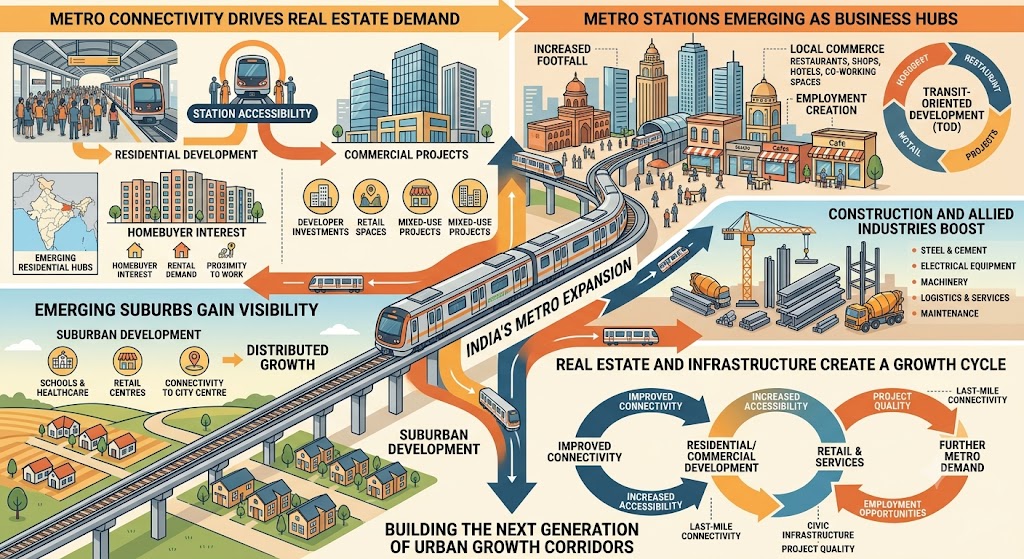
India’s rapid expansion of metro rail networks is creating a new wave of opportunities for real estate development, commercial activity and urban economic growth, as improved connectivity opens up emerging areas across major cities.
Metro infrastructure is increasingly becoming more than a solution to urban traffic congestion. New and extended corridors are connecting residential neighbourhoods with business districts, industrial clusters, airports and suburban areas, helping bring previously less-connected locations into the mainstream of urban development.
The growing network is also strengthening the relationship between public transport and real estate, with connectivity emerging as an important factor in the development of new residential and commercial destinations.
Metro Connectivity Drives New Real Estate Demand
Improved transportation can significantly influence the attractiveness of a location.
As metro stations become accessible to more neighbourhoods, areas along these corridors can gain greater interest from homebuyers, tenants, businesses and property developers. Better access to employment centres can make residential projects in emerging locations more practical for daily commuters.
For developers, metro-linked corridors can create opportunities to develop housing, offices, retail spaces and mixed-use projects as cities expand outward.
Metro Stations Emerging as Business Hubs
The economic impact of metro infrastructure can extend beyond property development.
Areas surrounding stations can attract shops, restaurants, offices, hotels, co-working spaces and other consumer-facing businesses as passenger movement increases. This can create local employment and encourage the development of supporting services.
Transit-Oriented Development (TOD) can further strengthen this trend by promoting compact, mixed-use neighbourhoods around public transportation corridors.
Construction and Allied Industries Get a Boost
Metro projects also create economic activity across a wide range of industries.
The construction of new corridors generates demand for steel, cement, electrical equipment, machinery, engineering services, construction materials and logistics. The operational phase creates additional requirements for maintenance, security, transportation and other urban services.
This makes metro expansion relevant not only to the infrastructure sector but also to businesses across the broader supply chain.
Emerging Suburbs Gain Greater Visibility
One of the most important effects of improved metro connectivity is the potential transformation of suburban and peripheral locations.
Better transport links can make these areas more accessible to people working in established business districts. This can encourage new housing developments and, over time, attract schools, healthcare facilities, retail centres, restaurants and other urban amenities.
Such development can create new economic corridors outside traditional city centres, allowing metropolitan regions to grow in a more distributed manner.
Real Estate and Infrastructure Create a Growth Cycle
Metro infrastructure and real estate development can reinforce each other.
When connectivity improves, an area can become more accessible. Greater accessibility can encourage residential and commercial development, while new development can create additional demand for retail, services and employment.
This creates a broader ecosystem linking transport, construction, property, retail, logistics and urban services.
The actual impact, however, depends on factors such as last-mile connectivity, road networks, civic infrastructure, employment opportunities, project quality and the pace at which supporting development takes place.
Building the Next Generation of Urban Growth Corridors
As Indian cities continue to expand, metro networks are becoming an important part of long-term urban planning. Their role is increasingly linked with the creation of new residential clusters, commercial centres and business districts.
With coordinated planning, metro-led development can help unlock the potential of emerging locations while improving mobility and connecting people with jobs, businesses and essential services.
For India’s growing metropolitan economy, metro expansion represents more than new transport infrastructure — it can help create fresh real estate opportunities, stimulate allied industries and open new corridors for sustainable urban growth.