
Delhi /Chennai , June 22 :Indian Institute of Technology Madras today handed over the first batch of 25 indigenously developed YD One ultra-lightweight wheelchairs to Army Hospital , the apex medical facility of the Armed Forces Medical Services under India’s Ministry of Defence, located in Delhi Cantonment.
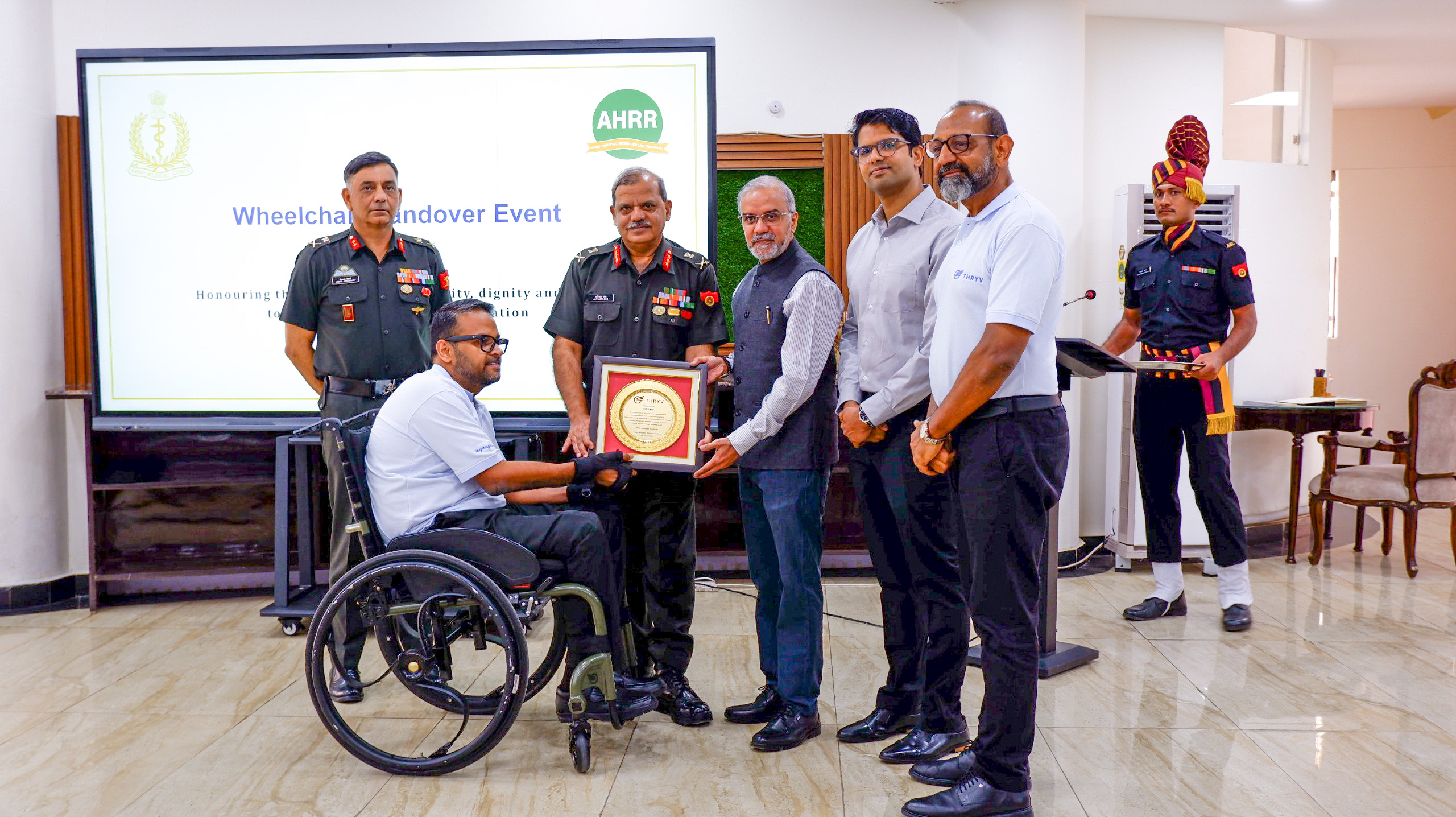
The handover marks the first tranche of a 100-wheelchair programme being implemented by IIT Madras under a Corporate Social Responsibility partnership funded by Fiserv, the global provider of payments and financial technology services. The remaining 75 wheelchairs will be delivered in subsequent batches over the coming months.
The YD One wheelchairs are manufactured by Thryv Mobility, an IIT Madras-incubated company specialising in the design and manufacture of high-quality, ultra-lightweight active wheelchairs. The wheelchairs have been developed at IIT Madras’s TTK Center for Rehabilitation Research and Device Development in collaboration with Thryv Mobility, with co-design input from wheelchair users.
Highlighting the importance of this initiative, Lt General Avinash Das, Commandant, Army Hospital (R&R), said,
“Mobility is fundamental to dignity and independence. We welcome this contribution from IIT Madras and Fiserv, which will directly support our patients and their families in regaining and maintaining mobility through devices designed and built in India.”
Speaking about the project, Prof. Manish Anand, Faculty, IIT Madras and TTK Center for Rehabilitation Research and Device Development (R2D2), IIT Madras, said,
“This handover represents what IIT Madras’s R2D2 was established to achieve – indigenous engineering for assistive technologies that meet the needs of Indian users at global standards. We are proud that our research has moved from the lab to serving those who have served the country, and grateful to Fiserv for enabling this scale of impact through their CSR support.”
Rear Admiral Deepak Bansal (Retd), Professor of Practice at IIT Madras, operates as the Head of Strategic Partnerships at Thryv Mobility. He has been instrumental in forging civil-military fusion besides mentoring young faculty, and connecting the dots between academia, industry, and the military establishment with the objective of reaching indigenous assistive technologies to those who need these devices most critically.
Mr. Sachin Kulkarni, President, Global Services, Fiserv, added,
“At Fiserv, Corporate Social Responsibility is reflective of our commitment to nurturing partnerships across communities where we live and work, while creating shared value for all. We remain committed to investing in initiatives that create lasting impact as we strive to promote capabilities, create opportunities, and nurture a collective future. Partnering with IIT Madras to deliver indigenously developed mobility solutions to the Armed Forces Medical Services brings together engineering excellence and meaningful social outcomes – exactly the kind of collaboration our CSR vision is built around.”
Mr. Justin Jesudas, CEO and Co-founder, Thryv Mobility and a wheelchair user, said,
“The YD One was designed and built in India to serve Indian users without compromise on quality. To see it now reaching the men and women of the Armed Forces, through the leadership of IIT Madras and the support of Fiserv, is the deepest validation of why this product exists.”
The YD One is not a traditional institutional wheelchair. It is an active, ultra-lightweight wheelchair designed for users to self-propel independently. The wheelchairs handed over to Army Hospital will be used within the hospital’s rehabilitation programme – introducing patients to active mobility as part of their rehabilitation journey, and demonstrating that independent, self-propelled movement is achievable.
For veterans, serving personnel, and dependents undergoing rehabilitation, that exposure changes what they understand to be possible. The initiative reflects the convergence of three priorities: indigenous research and development of advanced assistive technology, corporate philanthropy aligned with national disability priorities, and integration of active mobility into the rehabilitation pathway of those who have served the country.