
Kathmandu, April 13: Nepal’s newly formed government under Prime Minister Balendra Shah has unveiled an ambitious ‘Good Governance Blueprint 2082’ alongside a sweeping 100-point reform agenda, marking a decisive push to overhaul governance, digitise public services, and reshape the country’s economic and institutional framework.
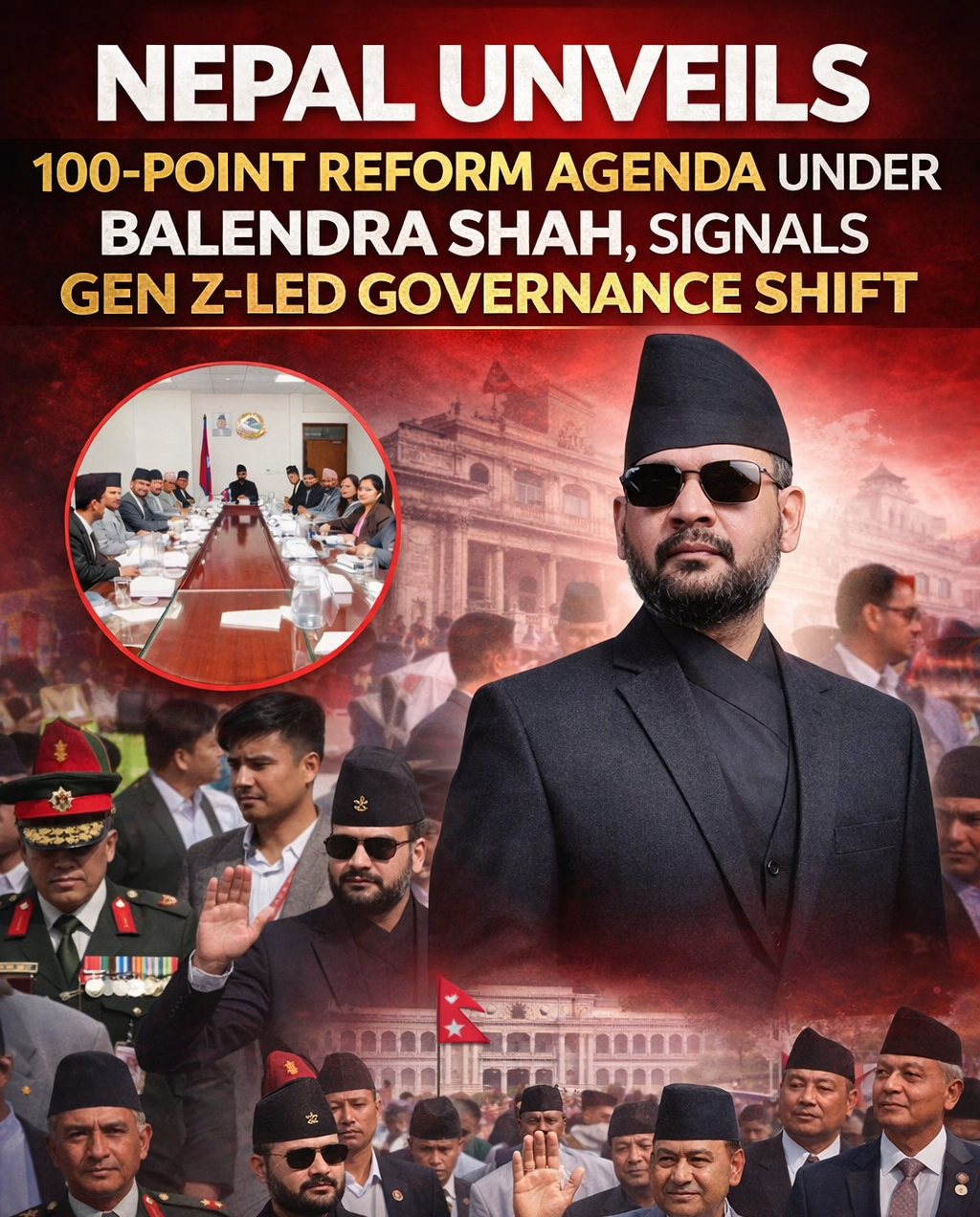
Approved during the first Cabinet meeting at Singha Durbar, the reform package reflects a transition toward efficiency, transparency, and citizen-first governance—aligned with the expectations of a younger, more digitally aware generation.
A Rapid Reform Push
Since taking office on March 27, the administration has moved swiftly to introduce structural and policy changes aimed at transforming the state from a regulator into a facilitator of growth. Key measures include capping the cabinet at 18 members, reducing administrative layers to three, and limiting central ministries to 17 within 30 days.
The government has also initiated wide-ranging reforms across anti-corruption, civil service restructuring, and digital governance to accelerate decision-making and improve institutional accountability.
Governance & Transparency at the Core
A major anti-corruption drive will investigate financial assets of politicians and officials dating back to 1991. Complementing this is a real-time digital platform that will allow citizens to track government promises, monitor execution, and evaluate performance—introducing unprecedented public oversight.
All ministries will operate under defined KPIs with mandatory monthly reporting to the Prime Minister’s Office, reinforcing performance-based governance.
Education & Institutional Reforms
In a landmark move to depoliticise education, political student unions will be phased out and replaced with non-partisan student councils. Additional education reforms include:
- No formal examinations up to Grade 5
- Mandatory government school attendance for children of ministers and senior officials
Civil service reforms further prohibit political affiliations for government employees and teachers, aiming to professionalise institutions and eliminate partisan influence.
Digital Governance & Citizen Services
The blueprint places strong emphasis on digital transformation. A unified governance framework will position the National ID as the primary access point for public services. Key initiatives include:
- 24×7 grievance redressal platforms
- Integrated service centres operating extended hours
- “Ask Once” policy for seamless data usage across departments
These measures aim to reduce bureaucratic friction and enhance service delivery efficiency.
Economic Strategy with Global Expertise
To steer economic reforms, the government has appointed Swarnim Wagle as Finance Minister. The strategy focuses on a digital-first, private sector-led growth model designed to attract domestic and foreign investment, create high-quality jobs, and drive structural transformation.
Reforms also include faster startup approvals, single-window clearance systems, and strengthened infrastructure planning across logistics, energy, and urban development.
A Gen Z-Driven Political Shift
Prime Minister Shah’s rise reflects a broader generational transformation in Nepal’s political landscape. Emerging from the September 2025 Gen Z-led protests, his leadership represents a shift toward accountability, meritocracy, and system-driven governance.
With a largely young cabinet drawn from non-traditional and reform-oriented backgrounds, the administration is positioning itself as a response to evolving public expectations.
Challenges Ahead
Despite the strong mandate, implementation faces notable hurdles. Early actions, including arrests linked to the Gen Z protest crackdown, have drawn legal scrutiny, with Nepal’s Supreme Court seeking clarification.
The government must also navigate structural challenges such as youth unemployment, brain drain, and entrenched institutional inefficiencies. Sustained execution and broad stakeholder alignment will be critical to delivering on reform promises.
A Defining Moment for Nepal
The ‘Good Governance Blueprint 2082’ represents one of Nepal’s most comprehensive reform efforts in recent years. By combining policy reform, digital innovation, and institutional restructuring, the government aims to build a resilient, transparent, and future-ready state.
As Nepal embarks on this transformation, the success of the agenda will depend on its ability to translate ambition into measurable outcomes while maintaining public trust and momentum.
